CatSignal
Context as Prior: Bayesian-Inspired Intent Inference for Non-Speaking Agents with a Household Cat Testbed
First-author accepted poster paper at the CVPR 2026 CV4Animals Workshop.
Many real-world agents cannot explicitly communicate their goals through language. In home environments, behavior is often partial, ambiguous, or noisy, while context is highly informative but risky if over-trusted. CatSignal frames this as probabilistic intent inference: spatial context acts as a prior over plausible intents, while pose dynamics and audio provide behavioral evidence.
INTENT: EXIT
INTENT: FOOD
INTENT: IDLE
Three latent intents in a domestic cat setting — EXIT, FOOD, and IDLE. Each clip combines synchronized visual and acoustic evidence, so the model reasons over bodily behavior and vocal expression instead of relying on context alone.
The Core Problem: Informative Context, Fragile Reasoning
In household environments, location provides strong clues about what the cat might want. Near the bowl, FOOD becomes plausible. Near the door, EXIT becomes plausible. But plausibility is not the same as certainty.
If context is treated as just another input feature, the model can collapse into brittle shortcut rules like near_bowl → FOOD or near_door → EXIT. This breaks down in ambiguous cases, especially when the cat is simply idle in a context-compatible location.
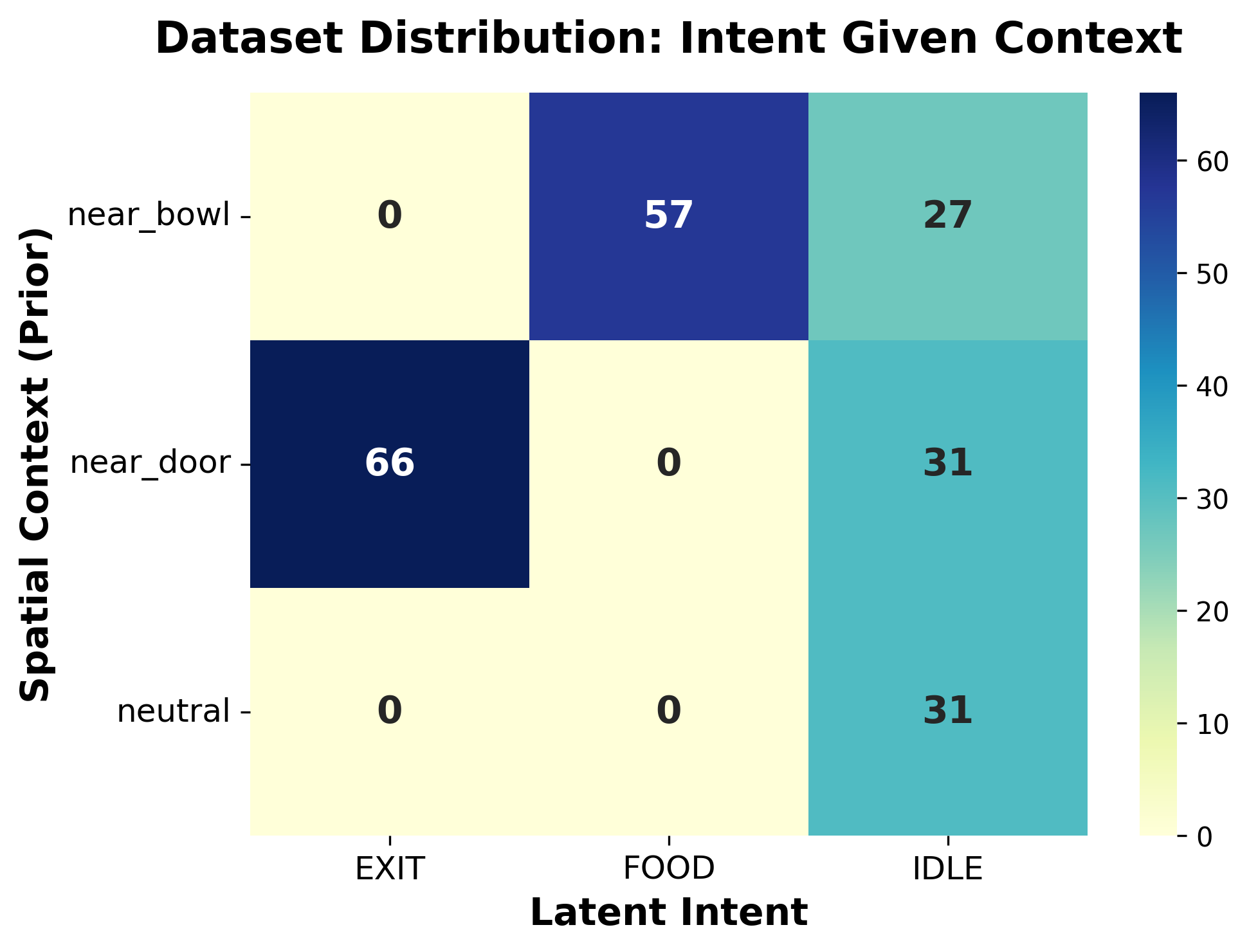
Context is Strong but Incomplete
Context sharply constrains which intents are feasible, but it does not fully determine whether the clip reflects active goal-directed behavior or context-compatible idling.
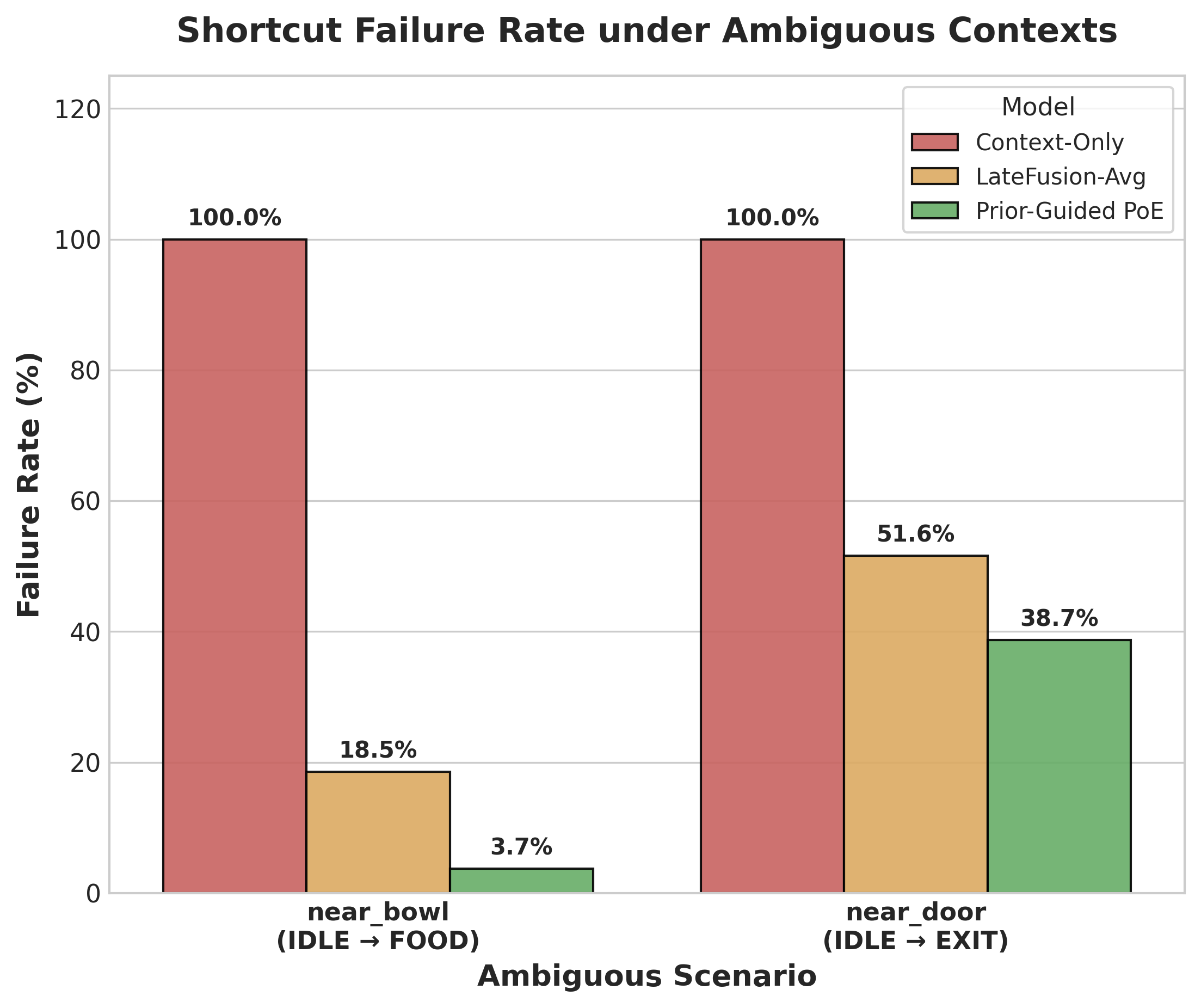
Shortcut Collapse Under Ambiguity
A context-only model collapses to deterministic shortcuts and reaches 100% failure on idle samples in both ambiguous regimes. CatSignal is designed to correct exactly this failure mode.
Methodology: Prior-Guided Product-of-Experts
CatSignal does not treat context as an ordinary input feature. Instead, it interprets spatial context as a prior over feasible intents, then updates that prior with observation-driven evidence from pose and audio.
Pose cues are extracted from DeepLabCut keypoints and summarized into motion descriptors, while audio cues are represented using synchronized acoustic features. These modality-specific experts are fused with context through a Product-of-Experts formulation, allowing behavioral evidence to correct a misleading contextual prior rather than merely mixing everything into a single feature representation.

Ambiguous Case Studies
The key question is not whether context matters. It clearly does. The real challenge is whether the model can avoid collapsing into context-based shortcuts when the observed behavior is ambiguous.
Case 1: Door Context, But No Exit IntentGround Truth: IDLE
Why this matters:
- Context prior: being near the door strongly suggests EXIT.
- Behavioral evidence: the observed pose and weak audio cues are more consistent with resting than active exit-seeking.
- Posterior update: the model suppresses the shortcut and shifts the final prediction toward IDLE.
Case 2: Bowl Context, But No Food IntentGround Truth: IDLE
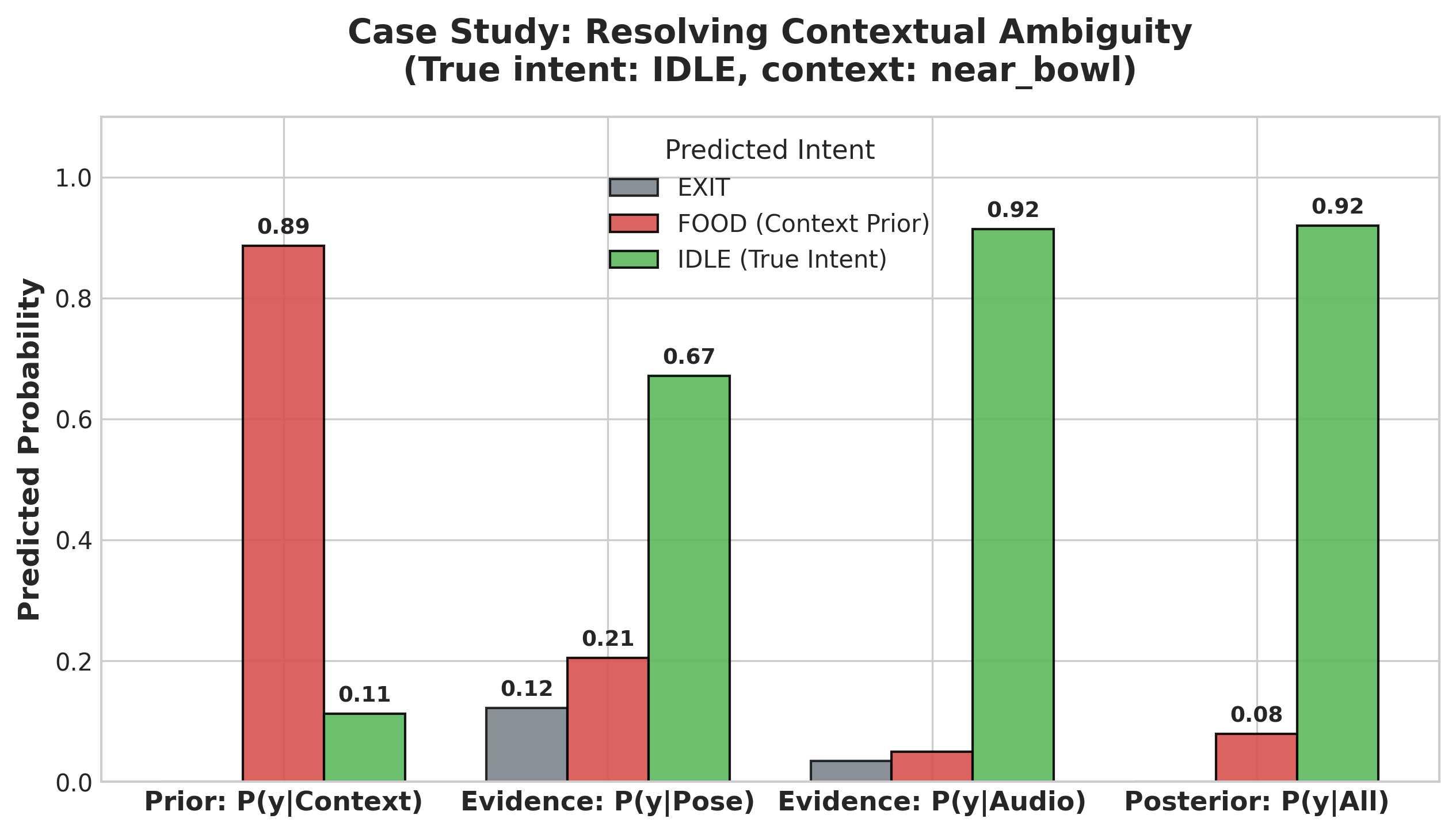
Posterior decomposition:
This is the canonical shortcut setting. The bowl creates a strong FOOD prior, but that does not guarantee active food-seeking. By separating prior from evidence, CatSignal allows pose and audio experts to push the final prediction back toward IDLE when the observed behavior does not support the contextual guess.
Results & Analysis
Under Leave-One-Video-Out evaluation, the full prior-guided Product-of-Experts model achieves the best overall accuracy. More importantly, it reduces context-driven shortcut failures in the ambiguous cases that matter most.
Performance Breakdown
The gain does not come from multimodality alone. It comes from assigning context a different role: prior knowledge rather than raw feature input.
| Method | Accuracy | Macro-F1 |
|---|---|---|
| Context-only | 60.87% | 0.7117 |
| Feature Concat | 71.83% | 0.6666 |
| LateFusion-Avg | 73.69% | 0.7666 |
| PoE-Ctx+Aud | 75.31% | 0.7549 |
| Prior-Guided PoE (Full) | 77.72% | 0.7460 |
Reliability Under Ambiguity
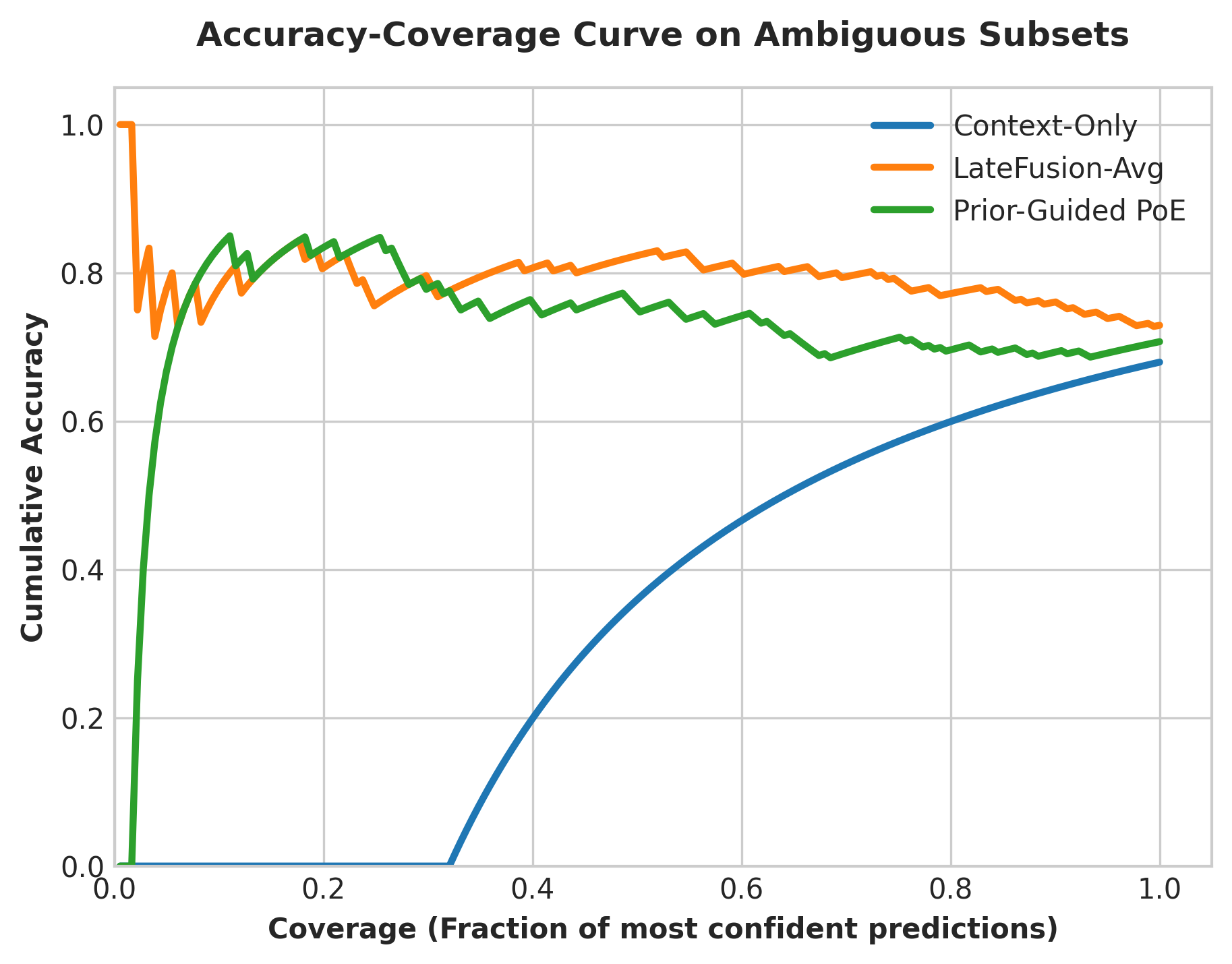
On ambiguous subsets, stronger fusion methods clearly outperform context-only inference. But the story is nuanced.
- Shortcut suppression: In the near-bowl setting, our method reduces IDLE → FOOD failure from 18.5% under late fusion to 3.7%.
- Near-door ambiguity: Our method also improves over late fusion there, reducing error from 51.6% to 38.7%.
- Confidence trade-off: Late fusion remains very strong on the accuracy–coverage curve, while our model complements it by achieving the best full-evaluation accuracy and better shortcut suppression.